Every time the government announces a new round of cooling measures, I get the same WhatsApp messages. "Is the government trying to bring prices down?" "Should I wait for a crash?" Here's my honest answer, with the government's own words and the actual price history.
What cooling measures actually are
"Cooling measures" is the name for a set of rules the government uses to manage the property market. The main ones today:
| Measure | What it does | Current setting |
|---|---|---|
| TDSR | Caps all your monthly debt repayments against income | 55% of gross monthly income |
| LTV limit | Caps how much a bank can lend | 75% for a first property loan |
| ABSD | Extra stamp duty on additional homes and foreign buyers | 20% for a citizen's 2nd home, 60% for foreigners |
| SSD | Tax on selling too soon | Applies if sold within 4 years (since July 2025) |
Are they meant to crash the market?
No, and the government says so. When it raised ABSD in April 2023, MOF, MND and MAS said the aim was to promote a sustainable property market and prioritise housing for owner-occupation. Their concern was that, left unchecked, prices could run ahead of economic fundamentals and keep rising faster than incomes.
The key words are run ahead. The target is runaway growth, not prices themselves. The government also adds supply through land sales, and it relaxes rules when the market cools enough. In March 2017, for example, it shortened the Seller's Stamp Duty period from 4 years to 3. You don't loosen the brakes if your goal is a crash.
Remember too that most Singaporeans' wealth is tied up in their homes, including HDB flats. A crash would hurt the very people the policies are meant to protect.
What happened last time: a soft landing
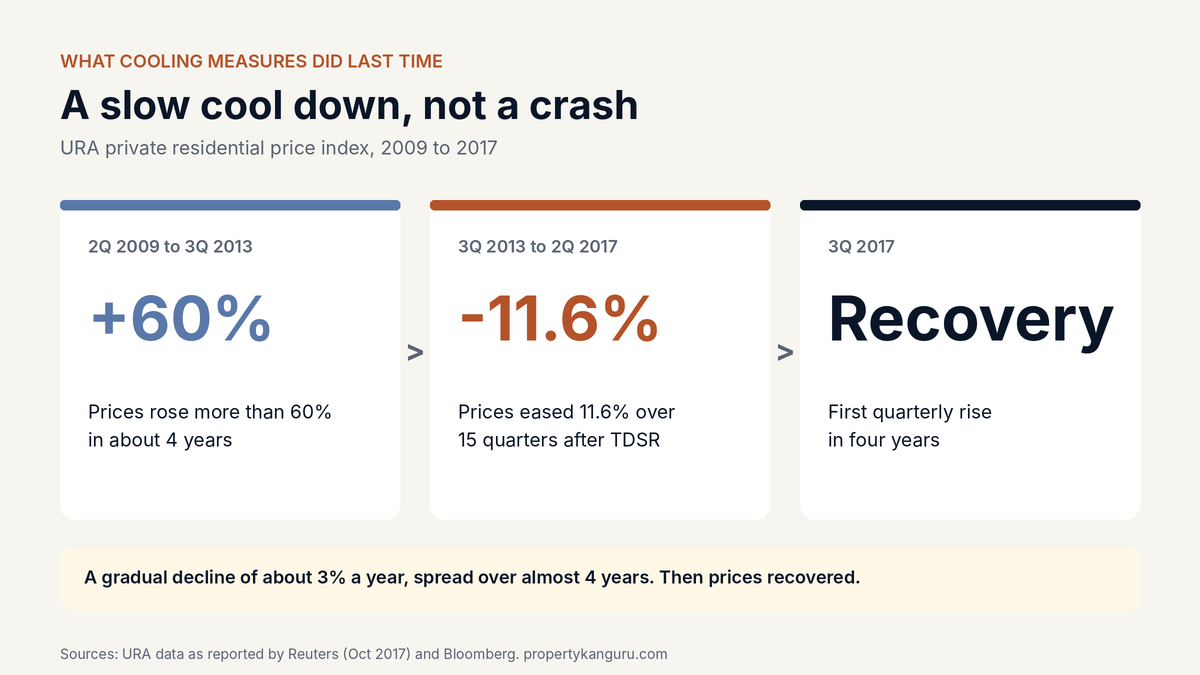
The best example is the last big cycle. Private home prices rose more than 60% from 2Q 2009 to the peak in 3Q 2013. TDSR came in June 2013, on top of earlier ABSD and SSD rules. Prices then eased for 15 quarters in a row, falling 11.6% in total, before rising again in 3Q 2017.
That's what a soft landing looks like: a gradual cool down over almost four years, not a sudden collapse. For comparison, the 2008 global financial crisis saw prices fall for four quarters in a row, from mid-2008 to mid-2009.
So, good or bad?
It depends who you are. Here are both sides fairly:
Why many see them as good
Stability. Prices move slowly, so owner-occupiers aren't at the mercy of wild swings. UBS's 2026 Bubble Index rates Singapore moderate risk and steady, which I covered in my last post.
Protection from overborrowing. TDSR means banks can't lend you more than your income can carry, even if you want them to.
Priority for owner-occupiers. A citizen buying their first home pays 0% ABSD, while investors and foreigners pay much more.
Why some see them as bad
Higher costs for upgraders and investors. Buying a second home means 20% ABSD upfront for citizens, or waiting to sell first.
Less flexibility. The 4 year SSD period and loan limits make it harder to change plans quickly.
Affordability is still stretched. The measures slow price growth, but they haven't made homes cheap. Wages still struggle to keep up with prices.
Why waiting for a crash can cost you
A lot of buyers have the same reflex. New measures are announced, so they put everything on hold and wait for prices to fall. Here's why I think that's often the wrong move, especially if you're buying a home to live in.
1. Every bounce back so far: the numbers
I went through URA's official private home price index for every major round of cooling measures since 2013. For each one, I took the price index in the quarter before the measure was announced and tracked what happened next.
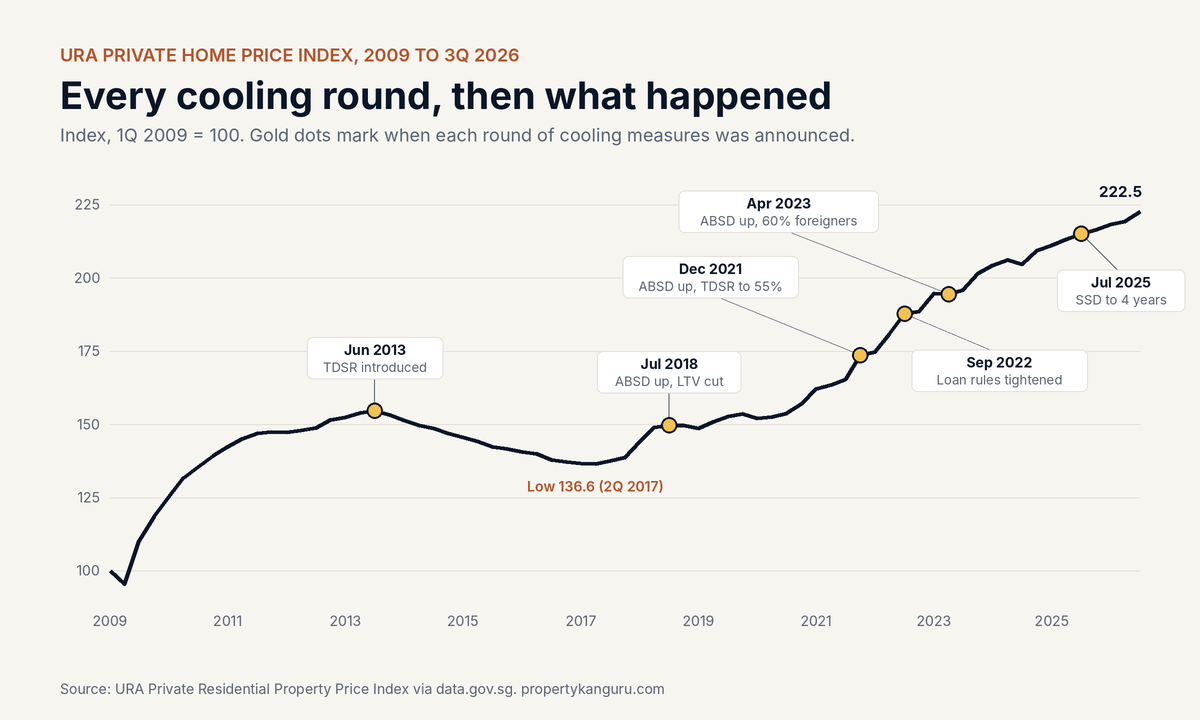
| Cooling round | Biggest dip after | Back above pre-measure level | 1 year later | By 3Q 2026 |
|---|---|---|---|---|
| Jun 2013 (TDSR) | -10.4%, low in 2Q 2017 | 3Q 2019, about 2 years after the low | -0.7% | +46.0% |
| Jul 2018 (ABSD up, LTV cut) | -0.3% | 2Q 2019, within a year | +1.2% | +49.3% |
| Dec 2021 (ABSD up, TDSR to 55%) | No dip | Never went below | +13.6% | +34.6% |
| Sep 2022 (loan rules tightened) | No dip | Never went below | +7.5% | +23.0% |
| Apr 2023 (ABSD up, 60% for foreigners) | -0.2% | 3Q 2023, two quarters later | +4.9% | +14.2% |
| Jul 2025 (SSD to 4 years) | No dip | Never went below | +2.9% | +4.4% |
All figures from URA's Private Residential Property Price Index (1Q 2009 = 100), via data.gov.sg. "Pre-measure level" is the index in the quarter before each announcement. Changes are for the overall index; individual projects and districts can differ.
What the numbers show:
Only one round led to a real decline. That was 2013, when TDSR changed how much everyone could borrow. Even then, prices eased only 10.4% from their pre-measure level, spread over four years, and were back above it about two years after the low.
Every round since 2018 has been a pause, not a fall. The biggest dip was 0.3%. Three of the five rounds saw no quarterly fall at all, and prices were higher a year later every time.
The buyers who waited for a crash paid more. A buyer who held off after the July 2018 measures, hoping for lower prices, would face a market about 49% higher today. Someone who bought during the 2017 quiet period, at the low of 136.6, has seen the index rise about 63% to 222.5 in 3Q 2026.
The fair conclusion: cooling measures have usually slowed the market, not reversed it. The best buys came from buying well during the quiet periods that follow, not from waiting for a crash that never came.
"Prices rose because of other things, not because of the measures." That's fair. After 2020, low interest rates, COVID construction delays and strong local demand pushed prices up. The measures didn't cause the bounce. What the data shows is that they slowed growth without stopping it. For a buyer, the takeaway is the same: the market didn't fall the way people feared.
"Waiting worked in 2013." Also fair. Someone who bought just before TDSR in early 2013 took about six and a half years to see the index back at their purchase level, before counting stamp duty and interest. That's the one round where holding back would have paid off. It came with a big change in borrowing rules, which is why it's worth reading each new measure on its own terms instead of assuming it'll play out like 2013.
"The index isn't my project." True. It's an average across the whole private market. In URA's 3Q 2026 flash estimate, for example, prime CCR prices slipped slightly while suburban condos rose. The right project and price matter more than the index.
"These numbers include inflation." Yes. The index tracks prices in dollars, not after inflation, so real gains are smaller than the headline figures, though still positive over these periods.
2. Fewer buyers means better negotiating power
Cooling measures mainly push investors and speculators out of the market. Fewer buyers chasing the same homes gives the ones still looking more choice and more room to negotiate. You can see it in the latest numbers: in 3Q 2026, developers sold 1,183 new private homes, down from 2,141 the quarter before. Quiet markets are where serious buyers get the pick of the stacks and the time to compare properly.
3. Most of the measures are not aimed at you
If you're a Singapore Citizen buying your first home, you pay 0% ABSD. Upgraders who are married, with at least one citizen spouse, can get ABSD refunded if they sell their first home in time. The higher taxes mostly land on investors, multiple-property owners and foreigners. So a measure that keeps them out is quietly working in your favour.
4. The rules make it safer to buy, not riskier
TDSR and loan limits mean you can't overborrow even if a bank wants to lend you more. The market is built for gradual moves, not crashes, so buying within your means during a cooling period is about as protected as it gets.
Plan around the rules, not against them
Use my stamp duty calculator for ABSD and BSD, the affordability calculator to see your TDSR limit, and read my ABSD guide if you're upgrading.
WhatsApp me
Sources: MOF, MND and MAS joint release "Measures for a Sustainable Property Market" (26 April 2023); URA price index data as reported by Reuters (2 October 2017), Bloomberg and Malay Mail; SRX record of the March 2017 SSD change; URA Private Residential Property Price Index (data.gov.sg) and 3Q 2026 real estate statistics (23 October 2026); MAS and IRAS for current rules. General information only, not financial advice.
Quick answers
Are Singapore cooling measures meant to crash property prices?
No. The government says the aim is a sustainable property market where prices don't run ahead of economic fundamentals, and it relaxes rules when the market cools, as it did with SSD in March 2017.
What happened to Singapore property prices after the 2013 cooling measures?
Private home prices eased for 15 consecutive quarters from 3Q 2013, falling 11.6% in total, then started rising again in 3Q 2017.
Should I wait to buy when new cooling measures are announced?
Not necessarily. Of six rounds of cooling measures since 2013, only the 2013 round led to a real decline, of about 10% over four years. Since 2018, the biggest dip after any round was 0.3%, and prices were higher a year later every time, based on URA's price index.
What are the current Singapore property cooling measures?
The main ones are the 55% Total Debt Servicing Ratio, a 75% loan limit for a first property loan, ABSD on additional homes and foreign buyers, and Seller's Stamp Duty if you sell within 4 years.

Real Estate Consultant, Huttons Asia Pte Ltd. CEA Reg. No. R067979C. Project Head, Western Australia Property Sales. WhatsApp 8205 1889