Every September, UBS publishes its Global Real Estate Bubble Index, which scores big-city housing markets on how far prices have drifted from what local incomes and rents can support. The 2026 edition came out on 22 September 2026 and covered 23 cities. Here's where Singapore landed, and what I think it means if you're buying here.
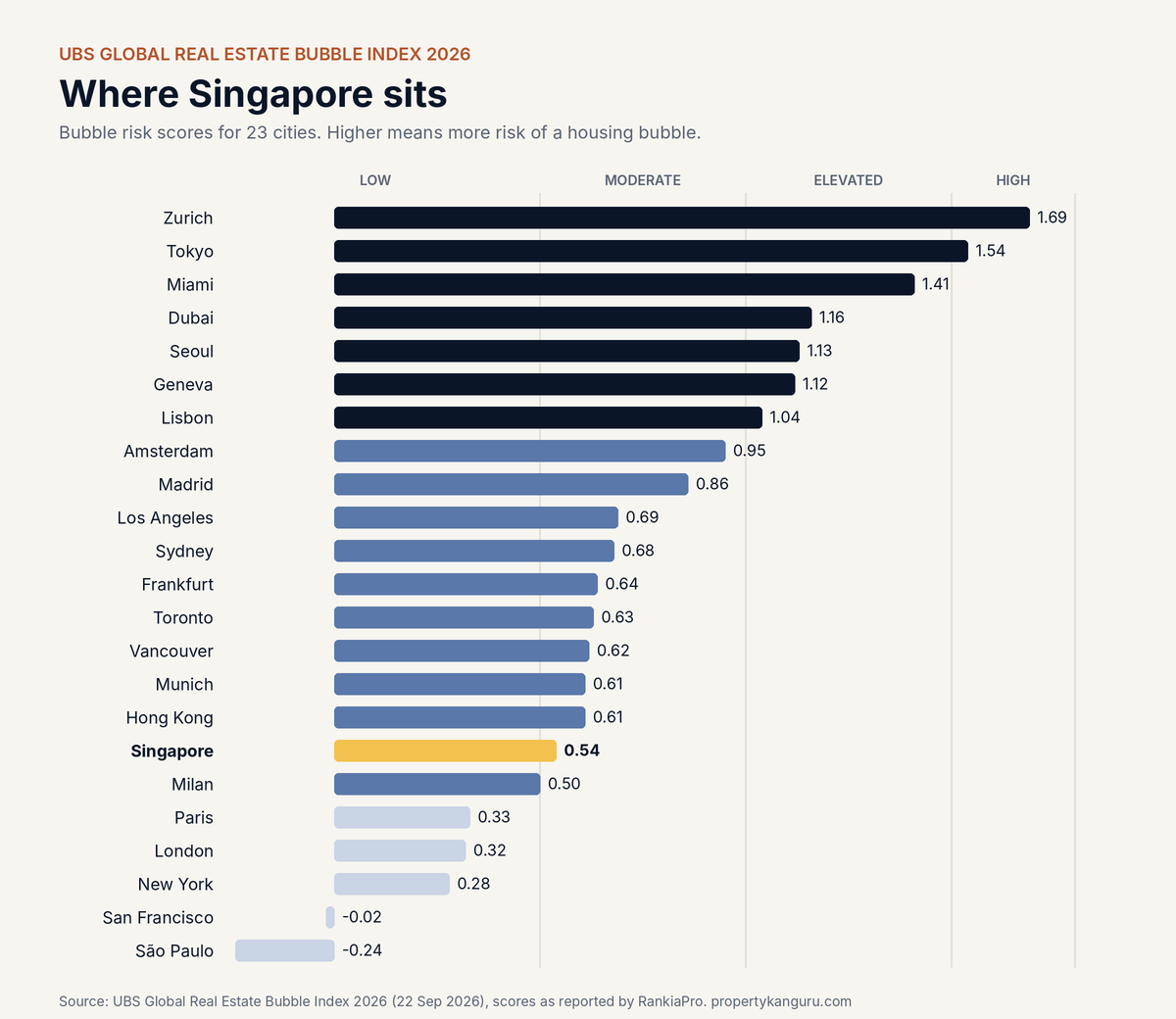
The headline: moderate risk, and steady
UBS puts Singapore in its moderate risk group, alongside Hong Kong, Sydney, Toronto, Vancouver and Los Angeles, and says Singapore's risk held steady this year. Zurich and Tokyo are the only two cities rated high risk. Miami, Dubai, Seoul, Geneva and Lisbon are rated elevated.
| Risk group | Score range | Cities in 2026 |
|---|---|---|
| High | Above 1.5 | Zurich, Tokyo |
| Elevated | 1.0 to 1.5 | Miami, Dubai, Seoul, Geneva, Lisbon |
| Moderate | 0.5 to 1.0 | Amsterdam, Madrid, Los Angeles, Sydney, Frankfurt, Toronto, Vancouver, Munich, Hong Kong, Singapore, Milan |
| Low | Below 0.5 | Paris, London, New York, San Francisco, São Paulo |
Singapore's score is about 0.54, the second lowest in the moderate group and only just above the low-risk line of 0.5. It's also lower than last year's score. Real prices (after inflation) rose only about 1% over the year, so this isn't a market running hot.
The groupings and the "held steady" comment are from UBS's own press release. The individual scores and price changes are as reported by RankiaPro from the UBS report.
Why Singapore stays steady: the rules do the work
Singapore's property market is one of the most actively managed in the world. These rules are why prices tend to move slowly rather than boom and bust:
1. You can only borrow what your income can carry
The Total Debt Servicing Ratio (TDSR) caps all your monthly debt repayments at 55% of your gross monthly income. Bank loans for a first property are capped at 75% of the price. People can't overstretch on cheap credit, and that's one of the main things that fuels bubbles elsewhere.
2. Speculation is expensive
ABSD makes buying extra homes costly: 20% for a Singapore Citizen's second home, 30% for a third, and 60% for foreigners. Since July 2025, Seller's Stamp Duty applies if you sell within 4 years, which stops quick flipping. My ABSD guide has the full rates.
3. The government steps in early
Cooling measures have been adjusted many times since 2009, usually when prices start running ahead. Buyers can expect the government to lean against overheating instead of letting it build.
What moderate risk does not mean
Moderate risk isn't zero risk, and it doesn't mean prices only go up. UBS also flags affordability as stretched in Singapore, which means local wages are struggling to keep pace with home prices. In plain terms, Singapore is a steady market, not a cheap one.
Planning your next move?
Check what you can comfortably afford with my affordability calculator, work out your stamp duty with the stamp duty calculator, and if you're upgrading from HDB, read my upgrade timeline guide.
WhatsApp me
Sources: UBS Global Real Estate Bubble Index 2026 press release (22 September 2026); RankiaPro summary of the UBS report (23 September 2026); MAS and IRAS for TDSR, LTV, ABSD and SSD rules. General information only, not financial advice.
Quick answers
Is Singapore in a property bubble in 2026?
UBS's Global Real Estate Bubble Index 2026 rates Singapore as moderate risk, with risk holding steady from last year. Only Zurich and Tokyo are rated high risk.
What is Singapore's score in the UBS Bubble Index 2026?
About 0.54, as reported from the UBS report. Scores of 0.5 to 1.0 count as moderate risk, so Singapore is near the lower end of that range.
Why is the Singapore property market considered stable?
Rules like the 55% Total Debt Servicing Ratio, 75% loan limits, ABSD and the 4 year Seller's Stamp Duty limit overborrowing and speculation, so prices tend to move gradually.

Real Estate Consultant, Huttons Asia Pte Ltd. CEA Reg. No. R067979C. Project Head, Western Australia Property Sales. WhatsApp 8205 1889