
"I'll wait for prices to drop first." I hear this almost every week. It sounds sensible. But nobody talks about what waiting does to your loan. Here's the example I used in my video, with the real numbers.
The buyer
| Item | Details |
|---|---|
| Age today | 40 |
| Monthly income | $12,000 |
| Home they want | $1,700,000 |
| Bank loan rate | 1.5% a year |
| Bank stress test rate | 4% a year (the MAS floor for home loans) |
Two rules decide the loan. To get the full 75% loan, the loan has to be paid off by age 65. And under the Total Debt Servicing Ratio (TDSR), your monthly repayments, tested at 4%, can't go above 55% of your income. With $12,000 a month, that limit is $6,600.
Scenario A: buy now, at 40
| Item | Amount |
|---|---|
| Price | $1,700,000 |
| Loan (75%) | $1,275,000 |
| Loan tenure (to age 65) | 25 years |
| Monthly instalment at 1.5% | $5,099 |
| Stress test at 4% | $6,730 |
The stress test comes in at $6,730, right at the edge of the $6,600 limit. It's tight but workable: about $25,000 more cash, or slightly higher income, and the bank approves the full loan.
Scenario B: wait 5 years for a 10% drop
Now let's assume the miracle happens. You wait 5 years and the same home drops 10%.
| Item | Amount |
|---|---|
| Price | $1,530,000 (10% lower) |
| Loan (75%) | $1,147,500 |
| Loan tenure (to age 65) | 20 years |
| Monthly instalment at 1.5% | $5,537 |
| Stress test at 4% | $6,954 |
What actually happened
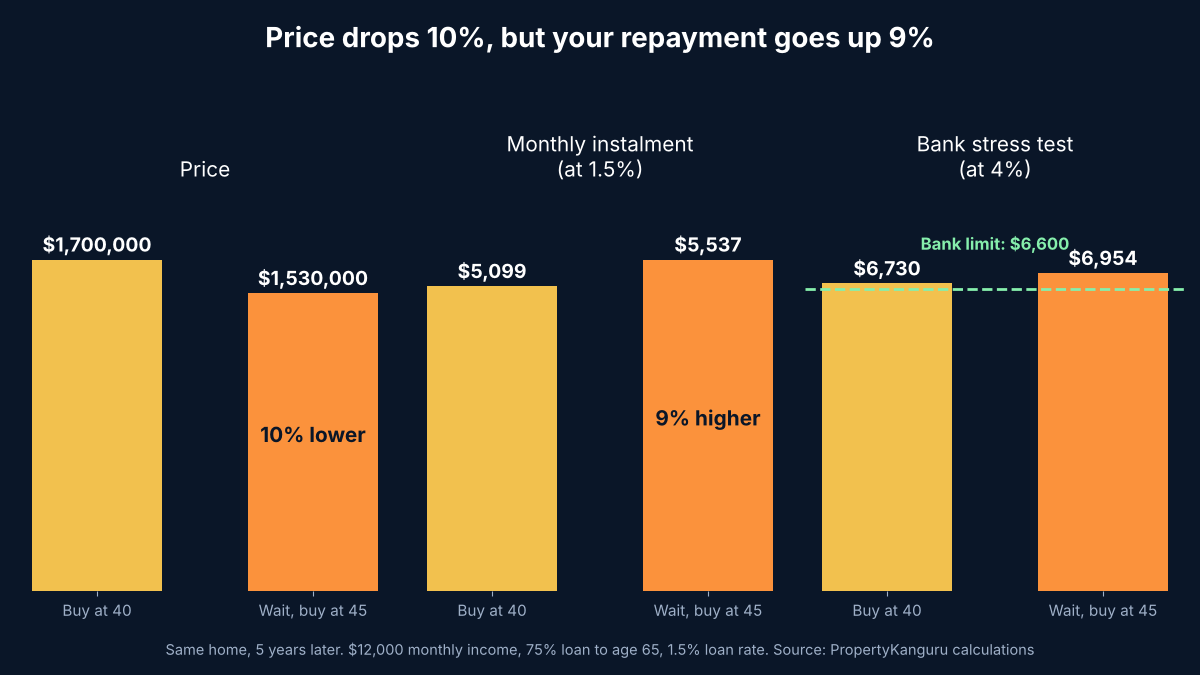
The price fell 10%, but your monthly repayment went up about 9%, from $5,099 to $5,537 (8.6% to be exact, or $438 more a month). Why? Because you're 5 years older, the loan has to be repaid in 20 years instead of 25. A shorter loan means a bigger monthly bill.
And the bank is now harder to please. At 45, the stress test is $6,954, about $350 over the limit. With the same $12,000 income, the bank can only lend about $1,089,000, not $1,147,500. So even at the lower price, you'd need about $58,000 more cash than the usual 25% downpayment. At 40, the gap was only about $25,000.
Some people don't get priced out by the market. They price themselves out by waiting.
Before you decide to wait and see
Run your own numbers for today and for a few years from now:
- Use the Can I buy this unit? check to see your loan limit, cash and CPF needed, and monthly instalment.
- Use the affordability calculator to see how much home your income supports.
- If you're upgrading from HDB, read my HDB to condo upgrade timeline.
WhatsApp meCheck what I can afford
Figures are worked out using standard loan repayment formulas, with a 75% loan, loan tenure ending at age 65, a 1.5% loan rate and the MAS 4% medium-term interest rate floor for the TDSR. Real loan rates, bank assessments and your own finances will differ. General information only, not financial advice.
Quick answers
Should I wait for property prices to drop before buying?
Not always. Even if prices fall 10%, your monthly repayment can go up, because being older shortens your loan tenure. In one example, a $1.7m home bought at 40 costs $5,099 a month, while the same home at $1.53m bought at 45 costs $5,537 a month.
Why does my monthly repayment go up when I'm older?
Banks give the full 75% loan only if it is repaid by age 65. The older you are, the shorter the loan, so each monthly instalment is bigger.
What is the TDSR stress test?
Banks test your loan at 4% a year (or their own rate if higher), and all your monthly debt repayments at that rate can't go above 55% of your gross monthly income.

Real Estate Consultant, Huttons Asia Pte Ltd. CEA Reg. No. R067979C. Project Head, Western Australia Property Sales. WhatsApp 8205 1889